
Circadian health
Circadian rhythm, insomnia, and delayed sleep phase
If you fall asleep hours after you mean to and cannot pry yourself awake in the morning, the trouble may not be classic insomnia at all. It may be a body clock set to the wrong hour. Delayed Sleep-Wake Phase Disorder (DSPD) is a circadian disorder in which the internal clock simply runs late, and the light hitting your eyes at night is one of the main forces pushing it later still. The trouble is that the bedroom you call dim is, to your clock, often still wide awake.
The connection
Most people read trouble falling asleep as insomnia and reach for sleep hygiene tips or sedatives. But a distinct group of poor sleepers have a circadian rhythm sleep-wake disorder: the clock is timed late, not broken. The signature of DSPD is a delayed dim-light melatonin onset (DLMO), the evening moment the brain starts releasing melatonin.
The strongest everyday input to that clock is light, picked up not by the rods and cones you see with but by melanopsin-containing retinal cells. Bright evening light from screens and lamps pushes the clock later; bright morning light pulls it earlier. So the matching response to a late clock is to retime light, and to measure the light that counts.
The science
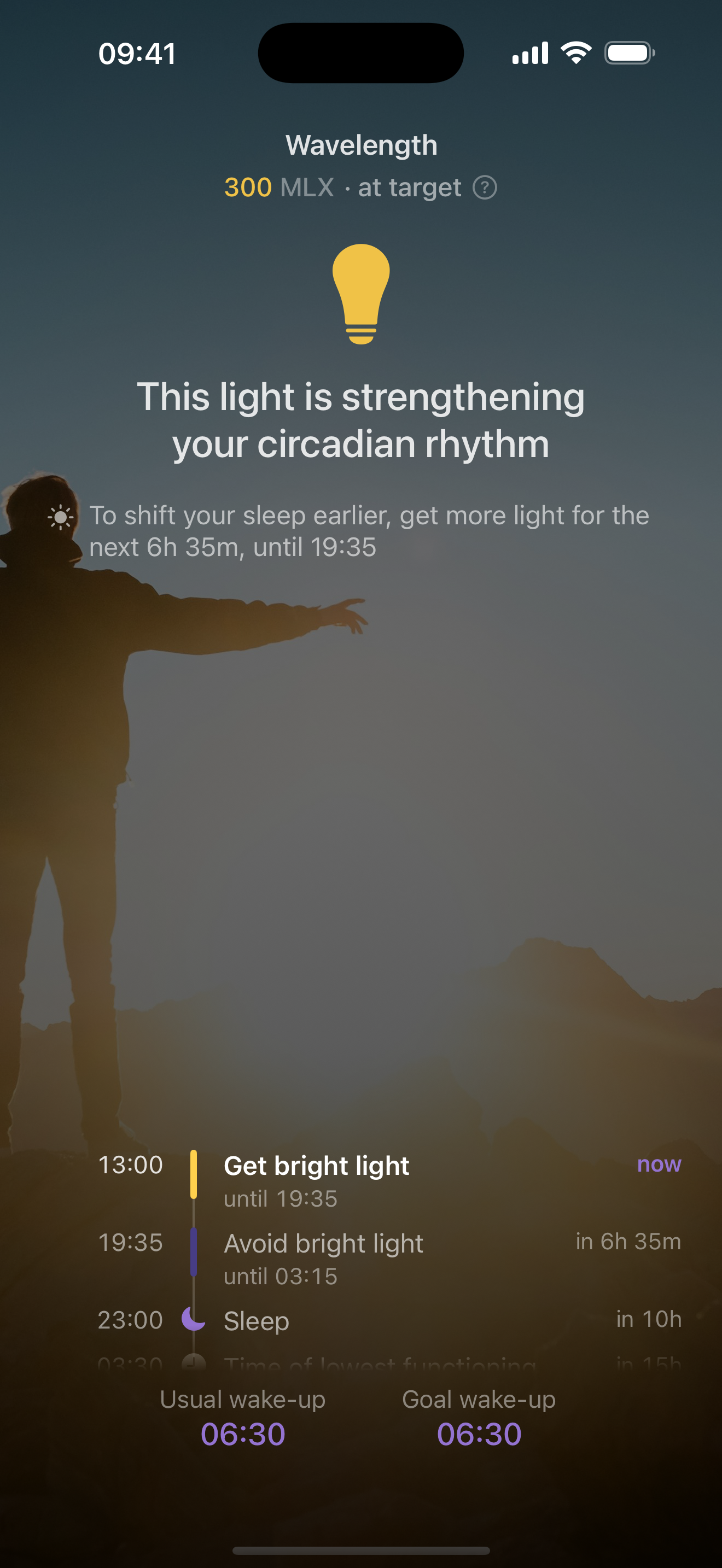
The clock in the suprachiasmatic nucleus is set mainly by light caught by intrinsically photosensitive retinal ganglion cells (ipRGCs) carrying melanopsin, most sensitive around 460 to 480 nm. An ordinary lux meter weights light by daytime vision, so it predicts circadian effect poorly; the quantity that matters is melanopic EDI, the basis of the consensus targets and of quantitative models like Hannay, Booth and Forger (2019). Reading it takes a meter tuned to that response rather than the eye, which is what a phone app like Wavelength does, turning an iPhone into a melanopic-lux reader for the bedroom that looks dark but is not.
How the clock responds depends on timing, captured by the light phase response curve. Evening light, and light before the core body temperature minimum, delays the clock; morning light after the minimum advances it. In DSPD the evening light lands squarely on the delay part of the curve, propping up an already-late clock, while the person usually sleeps right through the morning advance window.
Melatonin is both the readout and the lever. Gooley et al. (2011) showed that ordinary room light (under 200 lux) before bed delayed melatonin onset in 99 percent of people and cut melatonin by more than 50 percent during normal sleep hours. Because glowing screens and standard home lighting routinely overshoot the evening limits, the modern indoor environment actively drives sleep onset later.
What the research shows
A 2022 consensus turned decades of lab data into concrete melanopic targets for healthy adults (Brown et al., 2022): at least 250 lux melanopic EDI at the eye by day; in the evening, starting at least 3 hours before bed, no more than 10 lux; and during sleep, an ambient ceiling of 1 lux. That gives a measurable meaning to bright enough by day and dark enough at night.
Controlled experiments show how readily an evening screen blows past those limits. Chang et al. (2015) pitted a light-emitting e-reader against a printed book before bed: the e-reader cut evening melatonin by roughly 55 percent, pushed melatonin onset more than 1.5 hours later, stretched out the time to fall asleep, trimmed REM sleep, and left readers groggier the next morning. That is the DSPD loop in miniature.
DSPD really is its own thing, separate from chronic insomnia: leave people with DSPD on their own late schedule and they drop off quickly and sleep well, just late. It is far more common in adolescents and young adults, with teen prevalence estimates commonly around 3 to 8 percent, falling below 1 percent in middle age. The standard treatment is chronotherapy: timed morning bright light to advance the clock, restricted evening light, often with carefully timed low-dose melatonin (Auger et al., 2015).
Frequently asked questions
Is Delayed Sleep-Wake Phase Disorder the same as insomnia?
No. In DSPD the clock is set late but runs fine: on their own late schedule, people fall asleep fast and sleep well. Chronic insomnia is trouble sleeping even at a chosen, conventional bedtime. DSPD is treated by shifting the clock, not mainly by sedatives.
How common is DSPD and who gets it?
It is most common in adolescents and young adults, with teen estimates commonly around 3 to 8 percent, dropping below 1 percent by middle age. It often starts in adolescence and can carry into adulthood.
How does evening light from screens delay my sleep?
Evening light reaches the melanopsin cells in your retina, suppresses and delays melatonin, and so delays sleep onset. Room light under 200 lux delayed melatonin onset in 99 percent of people in one study, and an e-reader before bed delayed it by over 1.5 hours and cut it about 55 percent versus a printed book.
What melanopic light level should my evening and bedroom be?
The Brown et al. (2022) consensus caps melanopic EDI at 10 lux in the 3 hours before bed and at 1 lux in the sleep environment, with a daytime floor of 250 lux.
Why measure melanopic lux instead of using a regular lux meter?
A standard lux meter weights light by daytime vision and undercounts circadian impact. Melanopic EDI weights it by the melanopsin response that drives the clock, so a room that looks dim can still sit over the 10-lux evening limit. Reading melanopic lux directly is the only way to tell that your bedroom is propping your clock open when your eyes insist it is dark enough.
References
- Brown TM, et al. (2022). Recommendations for daytime, evening, and nighttime indoor light exposure. PLOS Biology.
- Gooley JJ, et al. (2011). Exposure to room light before bedtime suppresses melatonin onset and shortens melatonin duration in humans. JCEM.
- Chang AM, et al. (2015). Evening use of light-emitting eReaders negatively affects sleep, circadian timing, and next-morning alertness. PNAS.
- Auger RR, et al. (2015). Clinical practice guideline for the treatment of intrinsic circadian rhythm sleep-wake disorders. Journal of Clinical Sleep Medicine.
- Hannay KM, Booth V, Forger DB (2019). Macroscopic models for human circadian rhythms. Journal of Biological Rhythms.
How this page was researched. Every claim on this page is cited to the primary literature, listed in full under References. Where the evidence is preliminary, mixed, or drawn from a small study, the text says so rather than rounding it up.
Related guides
Wavelength is a wellness and education tool, not a medical device. This page summarizes published research and is not medical advice. Consult a qualified clinician about any health condition or before starting light therapy.