
Circadian health
Circadian rhythm, focus, and daytime alertness
The light hitting your eyes right now does more than let you see. It feeds a non-visual signal straight into your brain’s arousal circuitry. Bright, blue-rich daytime light sharpens reaction time, holds attention, and softens the mid-afternoon slump; dim indoor light leaves you foggy and slow. Most workspaces sit far below what the brain wants, and your eyes will not warn you.
The connection
We usually frame circadian biology around sleep, but the same photoreceptors that time your clock also fire a fast, direct alerting signal during the day. Specialized retinal cells (ipRGCs) report brightness to the brain regions that run arousal and cognition, a separate job from the slow work of shifting the clock’s phase.
So daytime light pays off twice: it anchors a healthy rhythm for better sleep tonight, and it lifts alertness and cognitive performance right now. The metric that captures what these cells see is melanopic lux, because the ipRGC system tunes to short-wavelength blue light rather than the green the visual system favors (Vandewalle et al., 2007).
The science
The ipRGCs carry melanopsin and project to non-visual targets, arousal and cognition centers among them. Using fMRI, Vandewalle et al. (2007) found that just 18 minutes of daytime blue (470 nm) versus green (550 nm) light shifted brain activity during a working-memory task, boosting responses in frontal and parietal cortex and the thalamus, evidence that light touches cognition almost at once through a melanopsin-based system.
Here is the point people miss: the daytime alerting effect does not need melatonin suppression. Daytime melatonin is already near zero, and light still works. Phipps-Nelson et al. (2003) found afternoon bright light (1,000 lux) cut sleepiness and improved psychomotor vigilance with no change in salivary melatonin, and Sahin and Figueiro (2013) landed in the same place using EEG markers of drowsiness near the post-lunch dip.
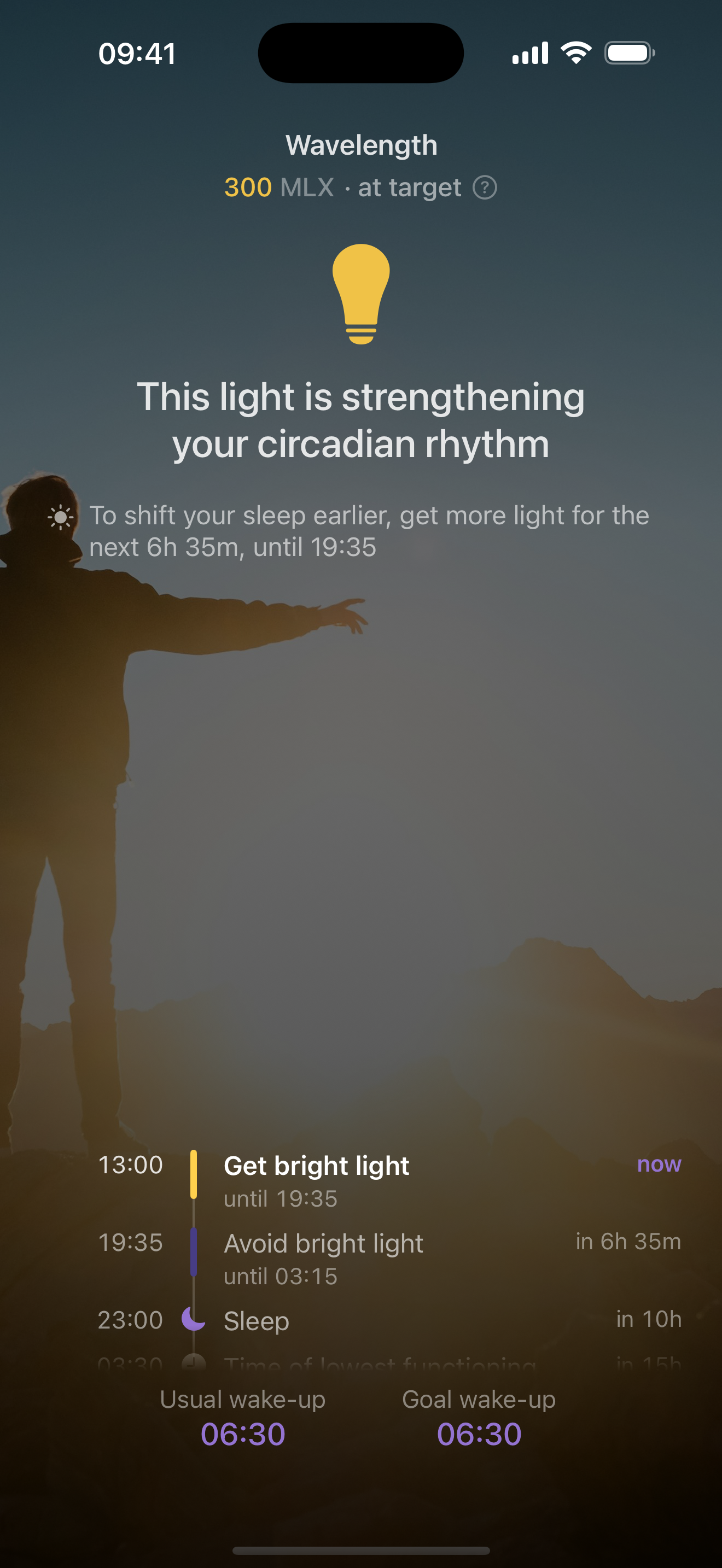
In a forced-desynchrony study that pried clock time apart from time-awake, Lok et al. (2022) found bright light (1,300 versus 6 lux) reliably improved objective alertness and performance whatever the circadian phase or hours awake. The catch: objective performance rose even when people felt no more alert, so they likely underestimate how much dim light is dragging them down. Since the feeling is no guide, the only way to know what a desk delivers is to measure it, which a phone app like Wavelength does by reading melanopic lux from an iPhone.
What the research shows
Field and lab studies point the same way. In an office study of more than 100 white-collar workers, Viola et al. (2008) found four weeks of blue-enriched white light improved self-reported alertness, concentration, performance, and evening fatigue. On the afternoon dip, Kaida et al. (2006) showed 30 minutes near a window (around 3,260 lux) headed off afternoon sleepiness on performance and arousal tests.
The evidence owns its limits. Souman et al. (2018), a systematic review of 68 studies, found that turning up white-light intensity raises subjective alertness in most studies, but the effects of color temperature and specific wavelengths during the day are shakier, and many studies were underpowered. The takeaway: you need enough light, and intensity (melanopic content) counts for more than chasing some exotic color temperature.
The flip side bites the next day. Boubekri et al. (2014) found office workers without window daylight slept worse, felt less vital, and slept less than workers with daylight access, tying too little daytime light straight to worse sleep and wellbeing.
Frequently asked questions
Does bright light actually make you more alert during the day, or just at night?
Both, by partly different routes. Daytime bright light cuts sleepiness and improves vigilance and cognitive performance, and studies show it does so without suppressing melatonin, so it is a direct alerting effect, not just a nighttime one.
How much light do I need at my desk for alertness?
The Brown et al. (2022) consensus calls for at least 250 melanopic lux at eye level during the day. Typical indoor office light often falls well short, which is why measuring matters.
Is blue light good or bad for focus?
It comes down to timing. Blue-rich light by day sharpens alertness, concentration, and cognitive brain responses. The same light at night wrecks sleep and hurts next-day function. Hence the rule: bright by day, dim and warm at night.
Why do I crash in the afternoon, and can light fix it?
The post-lunch dip is a built-in circadian and homeostatic drop in alertness. Light helps: 30 minutes near a window headed off afternoon sleepiness in controlled tests and lowered EEG drowsiness markers near the dip.
Why measure melanopic lux instead of just using a regular lux meter?
Standard lux is weighted to the visual system, but the alerting ipRGC system peaks in the blue. Melanopic lux weights light by what those cells actually answer to, so it is the number tied to alertness and circadian effects. Measuring it directly is how you find out a desk that feels fine is delivering a fraction of what your attention needs.
References
- Vandewalle G, et al. (2007). Wavelength-dependent modulation of brain responses to a working memory task by daytime light exposure. Cerebral Cortex.
- Phipps-Nelson J, et al. (2003). Daytime exposure to bright light decreases sleepiness and improves psychomotor vigilance performance. Sleep.
- Sahin L, Figueiro MG (2013). Alerting effects of short-wavelength (blue) and long-wavelength (red) lights in the afternoon. Physiology and Behavior.
- Lok R, et al. (2022). Bright light increases alertness and not cortisol in healthy men: a forced desynchrony study. Journal of Biological Rhythms.
- Viola AU, et al. (2008). Blue-enriched white light in the workplace improves self-reported alertness, performance and sleep quality. Scandinavian Journal of Work, Environment and Health.
- Kaida K, et al. (2006). Indoor exposure to natural bright light prevents afternoon sleepiness. Sleep.
- Boubekri M, et al. (2014). Impact of windows and daylight exposure on overall health and sleep quality of office workers. Journal of Clinical Sleep Medicine.
- Souman JL, et al. (2018). Acute alerting effects of light: a systematic literature review. Behavioural Brain Research.
- Brown TM, et al. (2022). Recommendations for daytime, evening, and nighttime indoor light exposure. PLOS Biology.
How this page was researched. Every claim on this page is cited to the primary literature, listed in full under References. Where the evidence is preliminary, mixed, or drawn from a small study, the text says so rather than rounding it up.
Related guides
Wavelength is a wellness and education tool, not a medical device. This page summarizes published research and is not medical advice. Consult a qualified clinician about any health condition or before starting light therapy.