
Circadian health
Circadian rhythm and jet lag
Jet lag is not just travel fatigue. It is a measurable gap between your internal clock and the clock on the wall where you land. Left alone, your body closes that gap at about one time zone a day. Light is the lever that speeds it up, or, used badly, slows it down, which leaves you standing in a strange hotel room with a real question: will the light in here help you or set you back, and could you tell the difference by looking?
The connection
Fly across several time zones and your suprachiasmatic nucleus stays pinned to home time while the local cues, the meals, and the sun all jump at once. That split produces the familiar wreckage: bad sleep, daytime fog, poor concentration, irritability, and an unhappy gut (Eastman and Burgess, 2009).
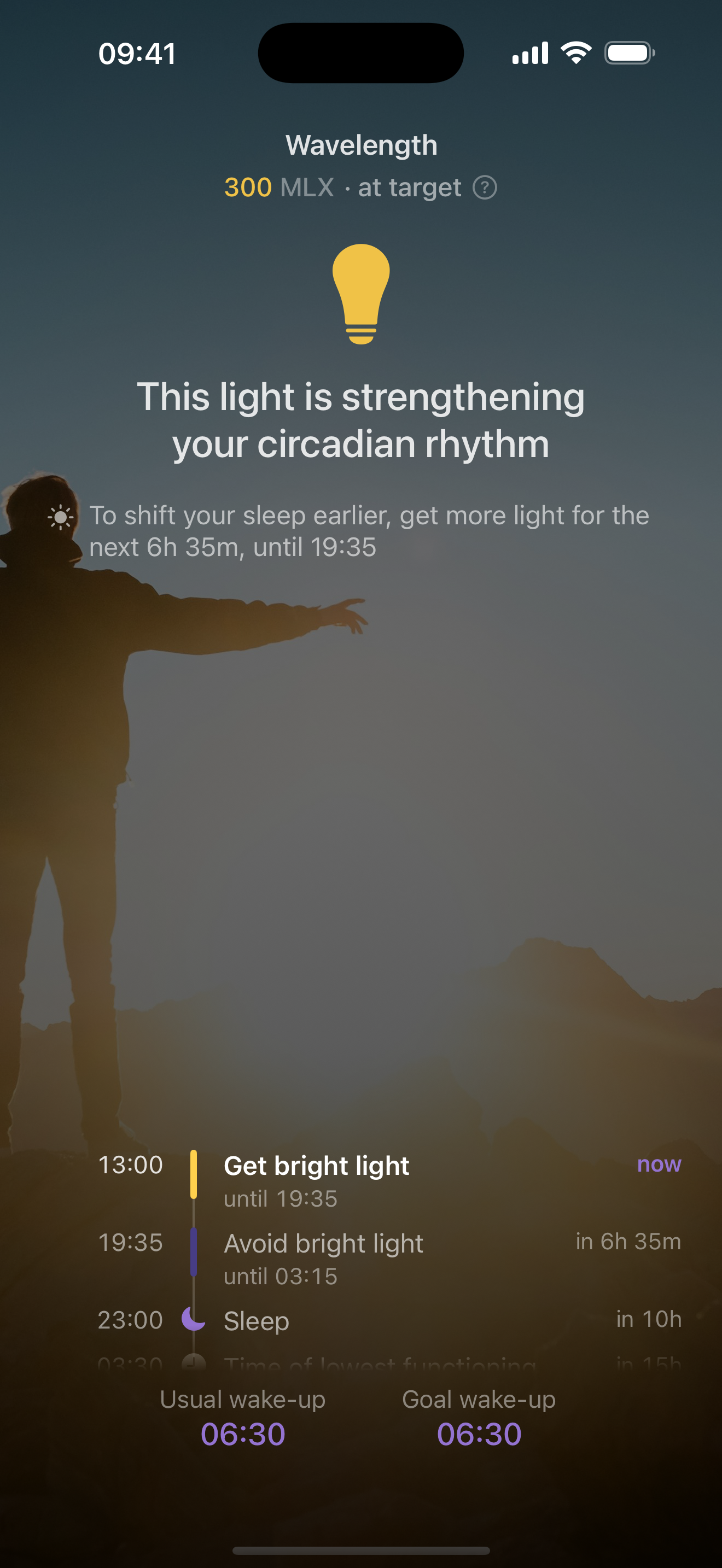
Light is the strongest signal for resetting the clock, but it cuts both ways. The same bright morning sun that helps you after an eastward flight will deepen the jet lag if your body still thinks it is the dead of night. Measuring melanopic lux tells you two things that matter here: whether the light around you is strong enough to move your clock, and whether it is dim enough to safely leave the clock alone. In an unfamiliar hotel room, where the eye is no guide at all, a phone reading like the one Wavelength gives from an iPhone settles both questions on the spot.
The science
The clock’s response to light follows a phase response curve (PRC). Khalsa et al. (2003) hit subjects with single 10,000-lux pulses at different circadian times and drew the canonical human light PRC, with a peak-to-trough swing of about 5 hours. The hinge is the core body temperature minimum (CBTmin), roughly 2 to 3 hours before your usual wake time. Light after CBTmin advances the clock (earlier); light before it delays the clock (later).
This is exactly why direction matters. After flying east you need to advance, which calls for morning light and dark evenings; but light too early, before your still-shifted CBTmin, drags the clock backward and stretches out recovery. Knowing the PRC is what makes avoiding light, not just chasing it, half the protocol.
The east-west asymmetry comes from the human clock running a touch longer than 24 hours, so it delays more readily than it advances. Eastman and Burgess (2009) clock re-entrainment at about 92 minutes per day going westward (delaying) versus only about 57 minutes per day going eastward (advancing), which is why eastward jet lag tends to hit harder. Melatonin works the opposite shift: evening melatonin advances the clock, morning melatonin delays it.
What the research shows
On its own, the clock resets slowly, about a day per time zone crossed (commonly cited as 1 to 1.5 days per zone). Well-timed bright light, plus dodging wrong-direction light, is the best-supported way to hurry it, because light moves the clock several times farther than any drug can (Khalsa et al., 2003; Eastman and Burgess, 2009).
For melatonin, the sturdiest synthesis is still the Cochrane review by Herxheimer and Petrie (2002): effective for travelers crossing five or more time zones, especially eastward. Doses from 0.5 to 5 mg worked about equally; timing is what decides, and melatonin at the wrong hour can set you back.
Modeling suggests you can in principle tailor a light schedule to each trip. Hannay, Booth and Forger (2019) built validated low-dimensional models of the human pacemaker that predict phase shifts from any light schedule, the kind of model behind traveler apps. Whether those app schedules beat simple rules of thumb has not been tested in large field trials, so treat the app output as a planning aid.
Frequently asked questions
Why is jet lag worse flying east than west?
The human circadian clock runs slightly longer than 24 hours, so it delays (westward) more easily than it advances (eastward). Measured re-entrainment is about 92 minutes per day delaying versus 57 minutes per day advancing, and roughly 75 percent of travelers report eastward as harder.
How long does jet lag last?
Untreated, the clock shifts about one time zone a day, commonly cited as 1 to 1.5 days per zone crossed. Well-timed light can cut that down noticeably.
When should I get light and when should I avoid it?
It turns on your core body temperature minimum (CBTmin), about 2 to 3 hours before your normal wake time. Light after CBTmin advances your clock (good for flying east); light before it delays the clock (good for flying west). Light at the wrong time pushes the clock the wrong way.
Does melatonin actually work for jet lag?
A Cochrane review found it effective for trips of five or more time zones, especially eastward, at 0.5 to 5 mg taken near destination bedtime. Take it at the wrong hour and it can backfire. It works best alongside properly timed light, not instead of it.
Why measure melanopic lux instead of just regular lux?
The clock reads a blue-weighted measure of light, not the brightness your eyes register. Ordinary indoor light can look bright while delivering too few melanopic lux to shift your clock, and a room that looks dim can still cross the level that wrecks sleep. In an unfamiliar hotel the gap between how a room looks and what it does is exactly what trips travelers up, which is why a measured reading of melanopic lux beats squinting at the curtains.
References
- Khalsa SBS, et al. (2003). A phase response curve to single bright light pulses in human subjects. The Journal of Physiology.
- Eastman CI, Burgess HJ (2009). How to travel the world without jet lag. Sleep Medicine Clinics.
- Herxheimer A, Petrie KJ (2002). Melatonin for the prevention and treatment of jet lag. Cochrane Database of Systematic Reviews.
- Hannay KM, Booth V, Forger DB (2019). Macroscopic models for human circadian rhythms. Journal of Biological Rhythms.
- Brown TM, et al. (2022). Recommendations for daytime, evening, and nighttime indoor light exposure. PLOS Biology.
How this page was researched. Every claim on this page is cited to the primary literature, listed in full under References. Where the evidence is preliminary, mixed, or drawn from a small study, the text says so rather than rounding it up.
Related guides
Wavelength is a wellness and education tool, not a medical device. This page summarizes published research and is not medical advice. Consult a qualified clinician about any health condition or before starting light therapy.