
Circadian health
Circadian rhythm, weight, and metabolism
Your body runs metabolism on a 24-hour schedule. The same meal pushes your blood sugar higher at 8 p.m. than at 8 a.m., because the internal clock throttles back insulin in the biological evening. Keep that clock confused with dim late mornings and bright nights, and the pattern is tied to weight gain, insulin resistance, and type 2 diabetes. What makes that hard to act on is that the clock takes its cues from a kind of light your eyes do not register as bright or dim at all.
The connection
Decades of epidemiology connect a misaligned clock to metabolic disease. Rotating night-shift workers face a higher risk of type 2 diabetes that climbs with years on shifts (Pan et al., 2011). Social jet lag goes with higher BMI (Roenneberg et al., 2012). People whose main daily light comes later in the day tend to carry more weight (Reid et al., 2014), and women who sleep with a light or TV on are likelier to gain (Park et al., 2019).
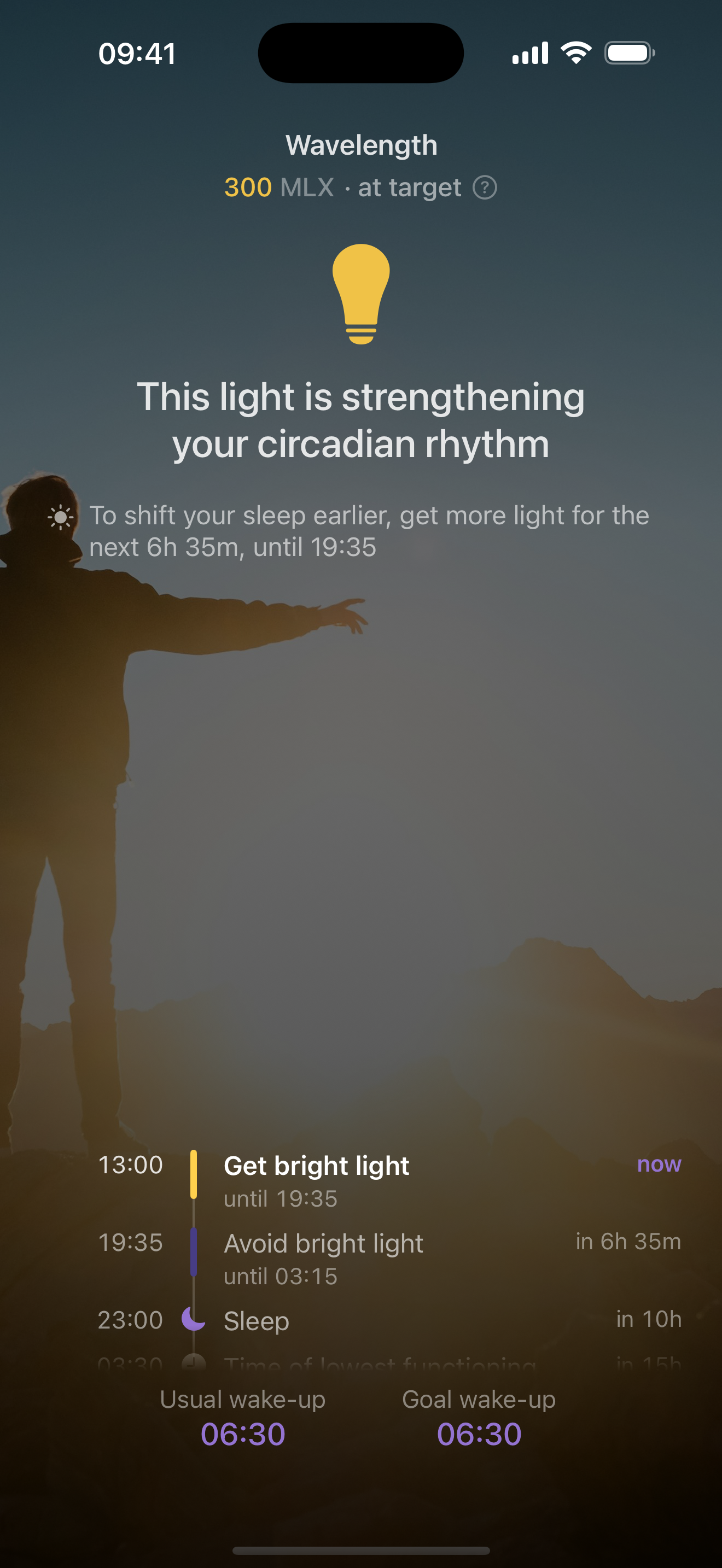
These are observational links, not proof that light timing alone drives weight. But they line up with controlled lab and animal work on a single coherent mechanism. The studies pin the effect to a kind of light the eye does not register as bright or dim, which is why they rely on wrist sensors; the same melanopic quantity is what a phone app like Wavelength reads from an iPhone.
The science
Your circadian system is more than the master clock in the brain. Nearly every organ, the liver, pancreas, fat, and muscle among them, carries its own peripheral clock that gates metabolism by time of day. Disrupt those clocks in animals and you get poor glucose tolerance, weak insulin secretion, and lower insulin sensitivity (Stenvers et al., 2019). The system evolved to burn fuel during the active daytime and stand down at night.
The cleanest human evidence comes from forced-desynchrony lab studies. Morris et al. (2015) fed healthy adults identical meals at biological 8 a.m. and 8 p.m. Post-meal glucose ran 17 percent higher in the biological evening, driven by a 27 percent drop in early-phase insulin. Separately, forcing circadian misalignment raised post-meal glucose another 6 percent through lower insulin sensitivity. Both the hour your clock thinks it is, and being out of sync with it, worsen glucose handling on their own.
Melatonin ties light to metabolism. Light at night suppresses melatonin; when melatonin is high, the pancreas is slower to release insulin. Rubio-Sastre et al. (2014) showed that giving melatonin acutely impaired glucose tolerance in healthy people, which is why a late meal, taken as melatonin rises, is a metabolically worse time to hand your body a glucose load.
What the research shows
On light itself: Reid et al. (2014) tracked 7 days of wrist-measured light in 54 adults and found the average clock time of meaningful light correlated with BMI (r = 0.51), still an independent predictor after adjusting for sleep timing, duration, age, sex, season, and activity. Earlier light, lower BMI. That points the same way as Park et al. (2019), where among roughly 44,000 women, sleeping with a light or television on went with more weight gain.
On meal timing, light timing’s behavioral twin: McHill et al. (2017) found that eating closer to one’s biological night went with higher body fat, independent of total calories and sleep.
The strongest causal meal-timing evidence comes from short trials. Sutton et al. (2018) put men with prediabetes on early time-restricted feeding and improved insulin sensitivity, blood pressure, and oxidative stress with no weight loss at all, so the benefit was timing, not calories. Wilkinson et al. (2020) found a self-chosen 10-hour eating window cut weight, blood pressure, and atherogenic lipids in metabolic syndrome. The trials are small and short, so read them as promising, not settled.
Frequently asked questions
Does light exposure affect weight and blood sugar?
Indirectly, through your circadian clock, which schedules insulin release and metabolism. Observational studies link later daily light and light at night to higher BMI and obesity risk, and lab studies show the clock changes glucose tolerance by time of day. Light timing correlates with body weight; it is not the only cause.
Why is my blood sugar higher in the evening?
It is your circadian clock, not just what you ate. In a controlled study, the identical meal produced 17 percent higher post-meal glucose at biological 8 p.m. than 8 a.m., on a 27 percent drop in early-phase insulin. Your body handles carbohydrate better earlier in the day.
Is night-shift work linked to diabetes?
Yes. Large prospective cohorts found rotating night-shift work raised type 2 diabetes risk, rising the longer someone worked shifts, and controlled studies show circadian misalignment itself lowers insulin sensitivity.
Does morning light help with weight?
The evidence is suggestive, not settled. People with earlier daily light tend to have lower BMI, and morning bright light is the most effective way to align the clock. It is a low-risk lever, but no large trial has shown morning light alone takes weight off.
Should I stop eating late at night?
Timing matters apart from calories. Eating closer to your biological night goes with higher body fat, and trials of earlier, time-restricted eating improved insulin sensitivity and cardiometabolic markers even without weight loss. Anchoring meals to daytime is well supported.
References
- Pan A, et al. (2011). Rotating night shift work and risk of type 2 diabetes: two prospective cohort studies in women. PLoS Medicine.
- Roenneberg T, et al. (2012). Social jetlag and obesity. Current Biology.
- Reid KJ, et al. (2014). Timing and intensity of light correlate with body weight in adults. PLOS ONE.
- Park YM, et al. (2019). Association of exposure to artificial light at night while sleeping with risk of obesity in women. JAMA Internal Medicine.
- Morris CJ, et al. (2015). Endogenous circadian system and circadian misalignment impact glucose tolerance via separate mechanisms. PNAS.
- Stenvers DJ, et al. (2019). Circadian clocks and insulin resistance. Nature Reviews Endocrinology.
- Rubio-Sastre P, et al. (2014). Acute melatonin administration impairs glucose tolerance in humans. Sleep.
- McHill AW, et al. (2017). Later circadian timing of food intake is associated with increased body fat. American Journal of Clinical Nutrition.
- Sutton EF, et al. (2018). Early time-restricted feeding improves insulin sensitivity, blood pressure, and oxidative stress in men with prediabetes. Cell Metabolism.
- Wilkinson MJ, et al. (2020). Ten-hour time-restricted eating reduces weight, blood pressure, and atherogenic lipids in metabolic syndrome. Cell Metabolism.
- Brown TM, et al. (2022). Recommendations for daytime, evening, and nighttime indoor light exposure. PLOS Biology.
How this page was researched. Every claim on this page is cited to the primary literature, listed in full under References. Where the evidence is preliminary, mixed, or drawn from a small study, the text says so rather than rounding it up.
Related guides
Wavelength is a wellness and education tool, not a medical device. This page summarizes published research and is not medical advice. Consult a qualified clinician about any health condition or before starting light therapy.