Measurement
How much morning light do you actually need?
The advice to get morning light is now everywhere, usually attached to a specific prescription: ten minutes, or thirty, or an hour, outdoors, within some window of waking. The prescriptions disagree with each other, and it is worth knowing why. The consensus recommendation in this field does not specify a morning dose at all. It specifies an intensity you should be above during the day, which is a different kind of instruction and a more useful one.
What the consensus actually says
The 2022 expert recommendations give one daytime number: a minimum of 250 melanopic EDI, measured vertically at eye level, roughly 1.2 m from the floor (Brown et al., 2022). It is a floor to stay above through the waking day, not a dose to take in the morning, and the paper is explicit that daylight should be the first way you meet it.
That framing matters because a duration without an intensity is close to meaningless. Thirty minutes at 200 melanopic EDI and thirty minutes at 20,000 are not the same intervention, and the difference between them is exactly the difference between a north-facing room and standing outside.
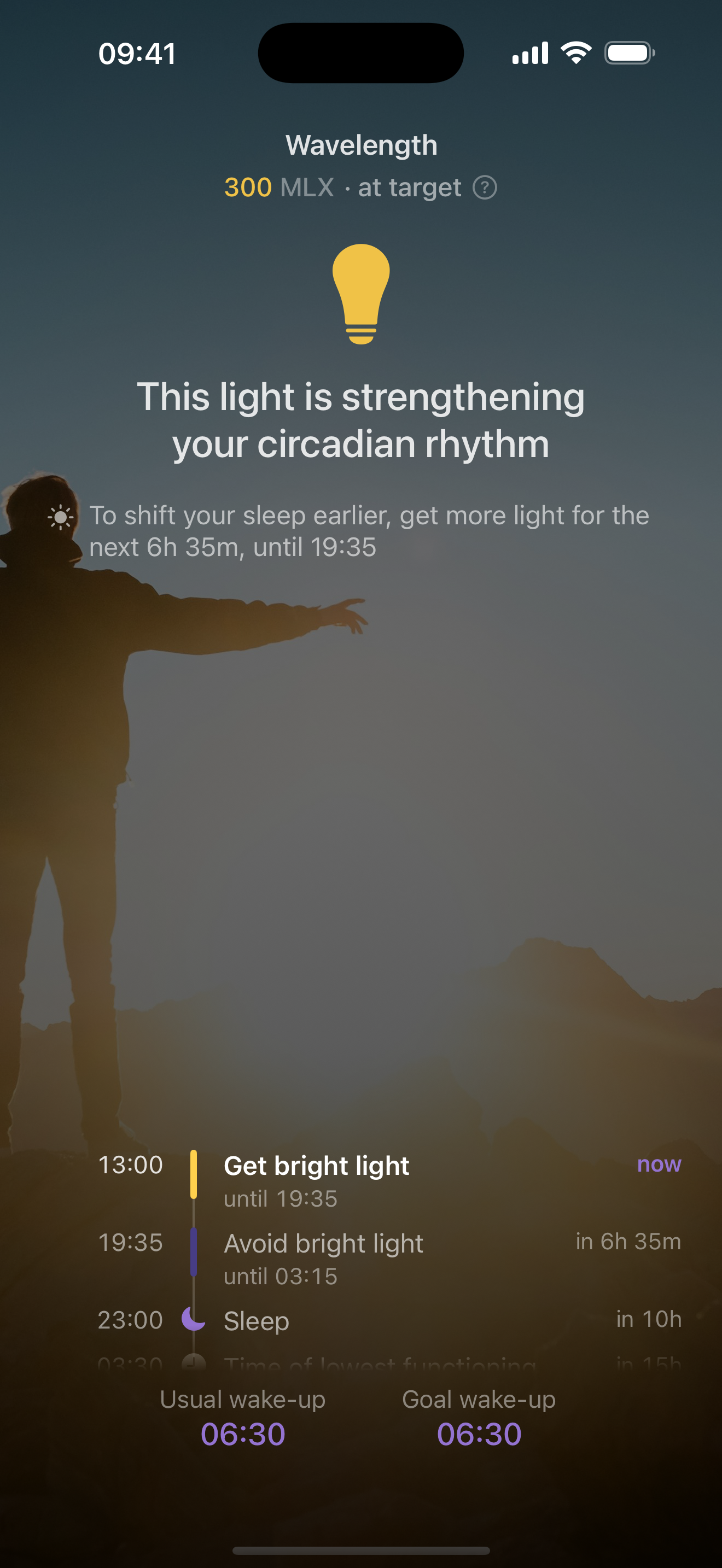
So the honest answer to how long is: long enough, at a level you have some way of knowing. Which puts the burden back on knowing the level, and that is not something the eye can supply, because it adapts. A room your eyes call bright can sit an order of magnitude under the floor without feeling like it. Reading the number off something (a phone meter such as Wavelength, or a laboratory instrument) is the only way to close the gap between how a room looks and what it is worth.
Where the thirty-minute rule came from
The familiar prescription, 10,000 lux for 30 minutes shortly after waking, is a genuine protocol with good evidence behind it, but it comes from the treatment literature for depression rather than from general circadian guidance. It is the dose used in randomized trials of bright light therapy, including the trial that tested light against fluoxetine in non-seasonal major depression (Lam et al., 2016).
Borrowing a clinical dose as everyday advice is not unreasonable, and it errs in a safe direction. But it should be labelled: it is the amount studied for treating a condition, not a physiological requirement established for healthy adults, and repeating it as though it were the latter is how a specific number acquires more authority than the evidence gives it.
Why timing changes the sign, not just the size
Light does not simply push the clock harder or softer. It pushes it in opposite directions depending on when it lands, which the phase response curve describes: light in the late night and early morning advances the clock, pulling you earlier, and light in the evening and early night delays it (Khalsa et al., 2003).
The crossover sits near your core temperature minimum, a couple of hours before you naturally wake. This is why morning light is singled out at all. It is not that morning light is stronger; it is that morning light is on the advancing side of the curve for most people, and it is the side almost everyone in a modern indoor life needs.
It is also why the advice inverts for some people. If you are trying to stay up later on purpose, for a westward flight or a run of night shifts, morning light is working against you.
How far short an ordinary day falls
The clearest measurement of the gap comes from taking people out of buildings. When Wright and colleagues sent participants camping for a week with no electric light, they received about four times more light during the day than in their normal lives, and their melatonin onset moved nearly two hours earlier, re-aligning to the sun (Wright et al., 2013).
Four times is the size of the deficit that ordinary indoor living imposes, and no amount of careful timing recovers it if the intensity is not there. It is also why going outside beats optimising a lamp: even an overcast day outdoors is far above what a lit room delivers.
None of which prescribes a number of minutes, and this page will not invent one. The workable version is: get outside reasonably early, prefer outdoors to indoors whenever the choice exists, and if you want to know whether a given room or a given morning is actually clearing the 250 floor, measure it rather than estimating from how bright it feels.
Frequently asked questions
How many minutes of morning light do I need?
There is no established minimum for healthy adults. The 2022 consensus specifies an intensity, at least 250 melanopic EDI at eye level during the day, rather than a morning duration. Duration only means something alongside an intensity, since thirty minutes indoors and thirty minutes outdoors can differ tenfold or more.
Where does the 10,000 lux for 30 minutes advice come from?
From clinical trials of bright light therapy for depression, where it is a treatment dose. It is well evidenced for that use. It was not derived as a daily requirement for healthy people, so it is better understood as a studied protocol than as a physiological target.
Is light through a window enough?
Usually much less than being outside. Glass cuts the level, and indoor positions are further from the sky. The 2022 recommendations name daylight as the first way to meet the daytime floor, and the practical test is whether the room clears 250 melanopic EDI at eye level, which most indoor spots do not.
Does morning light always help?
No. Light before your internal dawn advances the clock and light after your internal dusk delays it, so the same exposure has opposite effects depending on your phase. If you are deliberately shifting later, for a westward trip or night shifts, morning light works against the shift.
How much more light do people get outdoors?
In one study, participants camping for a week with no electric light received roughly four times more daytime light than in their ordinary lives, and their melatonin onset shifted nearly two hours earlier.
References
- Brown TM, et al. (2022). Recommendations for daytime, evening, and nighttime indoor light exposure. PLOS Biology.
- Wright KP Jr, et al. (2013). Entrainment of the human circadian clock to the natural light-dark cycle. Current Biology.
- Khalsa SBS, et al. (2003). A phase response curve to single bright light pulses in human subjects. The Journal of Physiology.
- Lam RW, et al. (2016). Bright light, fluoxetine, and the combination in nonseasonal major depression: a randomized clinical trial. JAMA Psychiatry.
How this page was researched. Every claim on this page is cited to the primary literature, listed in full under References. Where the evidence is preliminary, mixed, or drawn from a small study, the text says so rather than rounding it up.
Related guides
Wavelength is a wellness and education tool, not a medical device. This page summarizes published research and is not medical advice. Consult a qualified clinician about any health condition or before starting light therapy.