
Measurement
Melanopic lux, and why your light meter cannot see it
Two lamps can read exactly the same on a light meter and do completely different things to your body clock. That is not a defect in the meter. It is that the meter answers a question about how bright a light looks, and your clock is asking a different question entirely: how much of one narrow band of blue is arriving at your eyes. Melanopic lux is the number for that second question, and once you have it, most advice about evening light stops being folklore and becomes arithmetic.
Two curves, 75 nm apart
Vision runs on cones and rods. Your circadian clock runs mostly on a third receptor, found only in 2002: intrinsically photosensitive retinal ganglion cells, which contain the pigment melanopsin and wire straight into the brain’s master clock (Berson, Dunn and Takao, 2002). They contribute almost nothing to the picture you see. Their job is to report the time of day.
The two systems peak at different wavelengths. Daylight vision is most sensitive near 555 nm, in the green-yellow; melanopsin peaks near 480 nm, in the teal-blue. An ordinary lux meter weights everything it sees by the first of those curves, because lux is defined as a measure of visible brightness. For circadian purposes it is weighting the wrong band, and no amount of care in using it fixes that.
What the unit actually is
The formal quantity is melanopic equivalent daylight illuminance, melanopic EDI or mEDI, standardised in CIE S 026:2018. It answers a deliberately concrete question: how much standard daylight would stimulate melanopsin exactly as much as the light in front of you does? Answer in lux, and you have mEDI. “Melanopic lux” is the everyday name for the same idea, and the WELL Building Standard’s equivalent melanopic lux (EML) is a close relative computed against a slightly different reference, so the two do not interchange exactly.
Because it is defined against daylight, the unit carries its own sanity check. Daylight scores 1.0 by construction. Every artificial source is measured as a fraction of it, and the fraction is called the melanopic daylight efficacy ratio: multiply lux by that ratio and you get mEDI (Lucas et al., 2014).
So the whole problem reduces to one multiplier that a lux meter never tells you, and the multiplier is not close to constant.
How wrong a lux reading can be
Trinh, Bodrogi and Khanh (2023) computed that ratio for 4,214 real light sources. It ranged from 0.0797 to 1.46, an eighteen-fold spread. Two rooms measuring an identical number of lux can therefore differ by more than an order of magnitude in the only quantity your clock responds to.
The spread is systematic, not random, and it tracks colour temperature. In the same paper’s measured sample, a 2801 K warm-white LED scored 0.46 and a 5059 K cool-white LED scored 0.83. Both at 750 lx, the cool lamp delivers close to twice the circadian signal of the warm one, which is the entire reason “warm light in the evening” is real advice rather than decorating taste.
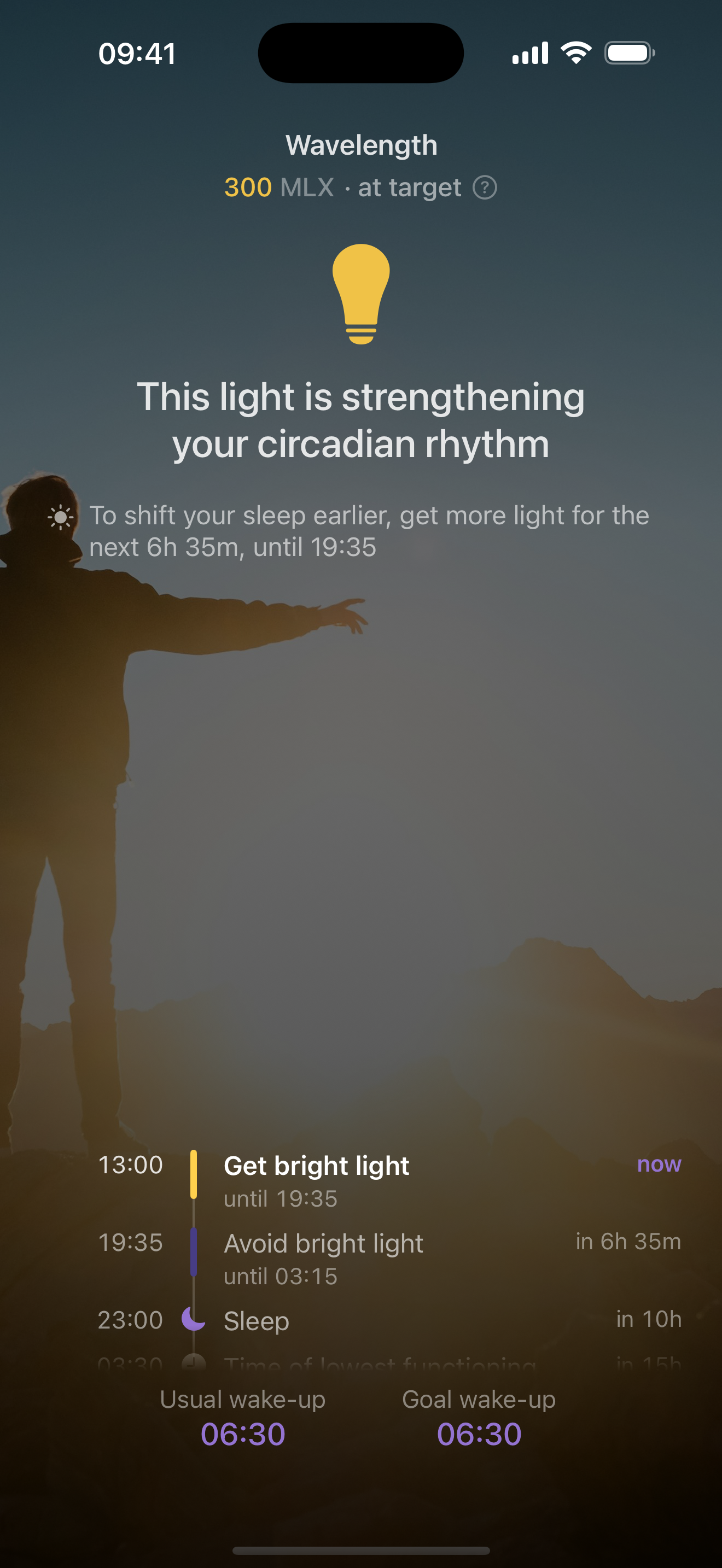
It also means a number quoted without its source spectrum is not a measurement. This is where the practical problem starts, because the eye is a poor instrument for the job: you cannot see the 480 nm band separately from everything else, so a room that feels dim and a room that is dim to your clock come apart constantly, and the only way to tell them apart is to read the quantity off something. A phone-based meter such as Wavelength estimates mEDI from the camera; a laboratory answer needs a spectroradiometer, which starts in the four figures.
The numbers to aim at
An expert consensus published in 2022 put figures on it, and they are the ones most later guidance repeats (Brown et al., 2022). During the day, at least 250 mEDI. In the three hours before bed, no more than 10. In the room you sleep in, under 1.
The measurement geometry is part of the recommendation and is usually the part people drop: readings are taken in the vertical plane at eye level, about 1.2 m from the floor, because what matters is the light arriving at your eyes and not the light landing on your desk. A meter lying face-up on a table is measuring a different room from the one you are sitting in.
Two honest caveats. These are consensus recommendations for healthy adults, not clinical thresholds, and the consensus itself says so. And the daytime figure is a floor rather than a target: a bright overcast day outdoors is far above 250, which is why the recommendation is easy to meet outside and hard to meet in an ordinary room.
Frequently asked questions
What is the difference between lux and melanopic lux?
Lux weights light by how bright it looks to human vision, which peaks near 555 nm. Melanopic lux weights it by the melanopsin response that sets your body clock, which peaks near 480 nm. The same light can score very differently on the two, so a lux meter cannot be used to check a melanopic target.
Is melanopic EDI the same as melanopic lux?
In everyday use, yes. Melanopic equivalent daylight illuminance (mEDI) is the formal quantity defined in CIE S 026:2018, and it is expressed in lux, so people say melanopic lux. The WELL Building Standard’s equivalent melanopic lux (EML) is computed against a different reference and does not convert one-for-one.
Can I measure melanopic lux with a normal light meter or a lux meter app?
Not directly. Both report photopic lux, weighted to the vision curve. You can convert if you know the source’s melanopic daylight efficacy ratio, but that ratio ranged from 0.08 to 1.46 across 4,214 sources in one 2023 analysis, so guessing it can be wrong by more than tenfold.
How much melanopic lux should I get during the day?
The 2022 consensus recommends at least 250 melanopic EDI during the daytime, measured vertically at eye level, dropping to no more than 10 in the three hours before bed and under 1 in the bedroom. These are recommendations for healthy adults, not medical thresholds.
Why does a warm bulb score lower than a cool one at the same brightness?
Because melanopic response depends on the shape of the spectrum, not the total. Warm sources put proportionally less energy near 480 nm. In one measured sample a 2801 K warm-white LED scored 0.46 against daylight and a 5059 K cool-white LED scored 0.83, so at equal lux the cool lamp delivers nearly twice the circadian signal.
References
- Berson DM, Dunn FA, Takao M (2002). Phototransduction by retinal ganglion cells that set the circadian clock. Science.
- Lucas RJ, et al. (2014). Measuring and using light in the melanopsin age. Trends in Neurosciences.
- CIE S 026:2018. System for Metrology of Optical Radiation for ipRGC-Influenced Responses to Light.
- Trinh VQ, Bodrogi P, Khanh TQ (2023). Determination and measurement of melanopic equivalent daylight (D65) illuminance (mEDI). Sensors.
- Brown TM, et al. (2022). Recommendations for daytime, evening, and nighttime indoor light exposure. PLOS Biology.
How this page was researched. Every claim on this page is cited to the primary literature, listed in full under References. Where the evidence is preliminary, mixed, or drawn from a small study, the text says so rather than rounding it up.
Related guides
Wavelength is a wellness and education tool, not a medical device. This page summarizes published research and is not medical advice. Consult a qualified clinician about any health condition or before starting light therapy.